Protecting passengers and themselves: Changi Airport staff on keeping the aviation hub running in the pandemic
Advertising
Singapore
Protecting passengers and themselves: Changi Airport staff on keeping the aviation hub running in the pandemic
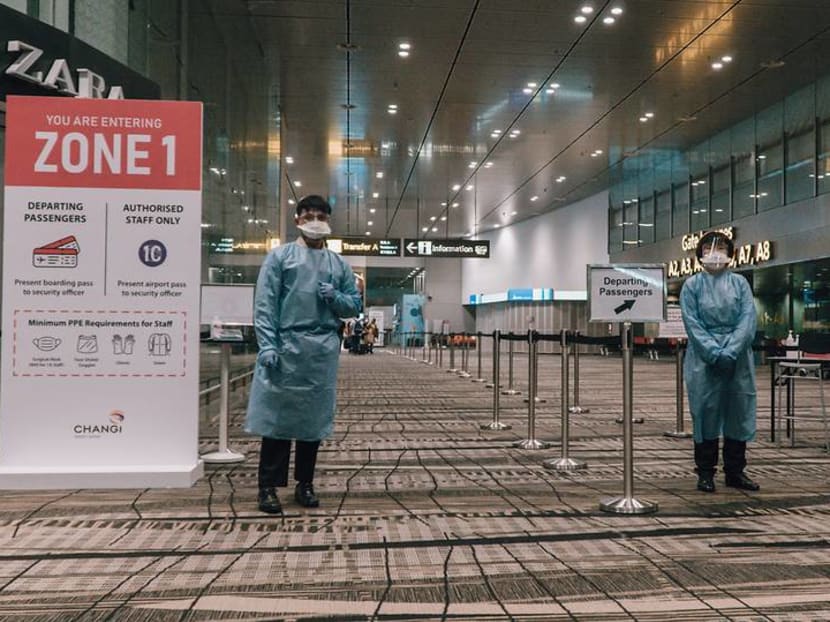
Changi Airport workers wearing personal protective equipment at Terminal 3, Jun vii, 2021. (Photo: Changi Airport Group)

SINGAPORE: Since the COVID-19 pandemic began, aviation worker Shermaine Goh has noticed a change in the behaviour of her fellow commuters.
On her daily motorbus rides to piece of work, Ms Goh said she has seen other commuters staring at her before hastily moving away.
"When they see united states in uniform, they tend to sit away from us," she said.
"I heard from my colleague that there was even a passenger that scolded her, saying why are you taking public transport, y'all're working in the aerodrome, you shouldn't exist spreading all this.
"Information technology's very sad to come across people like that," said Ms Goh.
The 28-year-erstwhile customer service officer with basis-handling firm SATS is ane of those working to ensure Singapore's Changi Drome remains running, even every bit the COVID-19 pandemic has desperately hit commercial aviation.
The airdrome – one of Asia'south busiest pre-pandemic – saw its passenger traffic nosedive from 68.iii million in 2022 to 11.8 one thousand thousand final year, a drop of nearly83 per cent.
Monthly passenger numbers at Changi dropped to a low of 24,500 in May 2022 - a decrease of more than 99 per cent from the 5.four one thousand thousand who passed through the airport during the aforementioned menses the previous year.
And in May this year, Changi Drome itself became a COVID-xix cluster, with more than 100 cases linked to it.
CHANGES TO ROUTINE
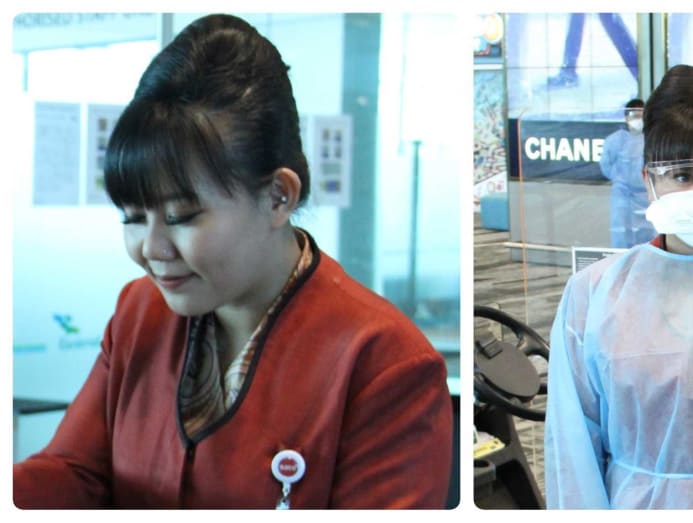
Ms Goh, who has been working with SATS for most seven years, was 4 months pregnant when Singapore made the unprecedented conclusion of closing its borders in late March last twelvemonth.
She shared with CNA her many concerns at the fourth dimension – from contracting the virus and raising a child in the midst of a global pandemic to worries that she would lose her chore as COVID-19 dilapidated the aviation sector.
Ms Goh gave birth to a baby boy in August last year and nevertheless works at the aerodrome, albeit in a different capacity.
Prior to the pandemic, she worked at SATS Premier Cheque-In Lounge, serving jet-setting fantabulous and business-class passengers.
Now, decked in personal protective equipment (PPE) – including an N95 mask, face shield and medical gown – Ms Goh's responsibilities include escorting passengers from high-hazard regions to transit holding areas, and ensuring travellers stay within their segregated zones to avert the risk of spreading infection.
This PPE must be changed after every flight.

Changi Airport Group (CAG) terminal managing director Javen Chua also at present has to don PPE when making his manner effectually the airport, with the specific equipment required depending on the assessed run a risk level of a specific area.
Having to habiliment PPE, and having to navigate segregated zones, has increased his response time to incidents, which range from identifying malfunctioning lights to assisting stranded passengers, said the 35-year-old.
Mr Chua said he keeps current with updates to the COVID-19 situation, given the bear upon it has on the way he works.
Ms Goh as well said she has to continue up-to-date, due to the irresolute gamble levels for visitors from different regions as well every bit the diverse documents needed to prove they accept been cleared to travel.
Getting vaccinated earlier this year gave her peace of mind, she said, noting she also regularly undergoes p olymerase chain reaction (PCR) tests as role of her task.
Still, there are the occasional scares, such as on one occasion when Ms Goh had to handle a passenger who got off the plane with a loftier fever and had to be brought to a quarantine area. He later tested negative for COVID-nineteen.

Changes have also occurred in the air.
Jetstar Asia cabin coiffure member Vicky Wee said she now has to distribute sanitising wipes to passengers as they board, in addition to wearing PPE when serving meals to passengers.
The 61-year-old, who has been flying with Jetstar Asia for the past decade, said her duties also include reminding passengers to keep their masks on and maintain social distancing while on board.
About passengers are compliant, Ms Wee said, though she notes an occasion when a passenger mistook a sleep mask – given out in the airline's civilities kit – as a face mask, wearing it over his oral fissure and nose.
Barring a brief menses last year when the upkeep carrier suspended its flights, Ms Wee said she has served on flights throughout the pandemic.
Pilot Mitchell Soh, on the other mitt, was grounded for several months after the COVID-19 outbreak began, flying for Jetstar Asia once again just later on being chosen dorsum for training in November final yr.
Noting the airline helped its staff detect other jobs during the downtime, the 34-year-old senior first officeholder said he worked in a very different role for several months – as an auditor with the Ministry of Social and Family Development, ensuring organisations under its purview complied with COVID-19 measures.
Though he has since returned to flying, the reduced number of flights now ways he is still able to do auditing part-time for the ministry while also ensuring he gets sufficient balance between flights.
SIGNS OF RECOVERY?
At that place are signs of recovery on the horizon for aviation.
Figures from CAG show that passenger traffic, while not nevertheless at pre-pandemic levels, have increased from final year. In that location were 178,000 passenger movements at Changi in June, a 270 per cent increase from the aforementioned menstruation last yr.
Singapore Airlines (SIA) said at that place are now two,200 active pilots across SIA Group, comprising the national carrier and low-cost carrier Scoot.
This is almost 90 per cent of pilots employed by the group, it said, calculation that well-nigh 80 per cent of its cabin crew staff – or around half-dozen,500 of them – are agile.
It declined to provide more details regarding these figures, citing commercial sensitivities.
Jetstar Asia said it has resumed flight to nine destinations, with six planes reactivated and more than crew members returning to work.
"At this phase, we'll add flights in line with border openings and relaxation of policies for vaccinated travellers, with Phuket being the 10th destination we'll resume flying to from early September," said a spokesperson for the airline.
The spokesperson added that virtually 50 per cent of its pilots and cabin coiffure are dorsum at work, a number it expects to increase as international travel recovers.
"The pace and uptake of Singapore'southward vaccination roll-out programme is very encouraging and together with the broader reopening plan, nosotros promise that some leisure travel may be possible before the finish of the year," Jetstar Asia added.
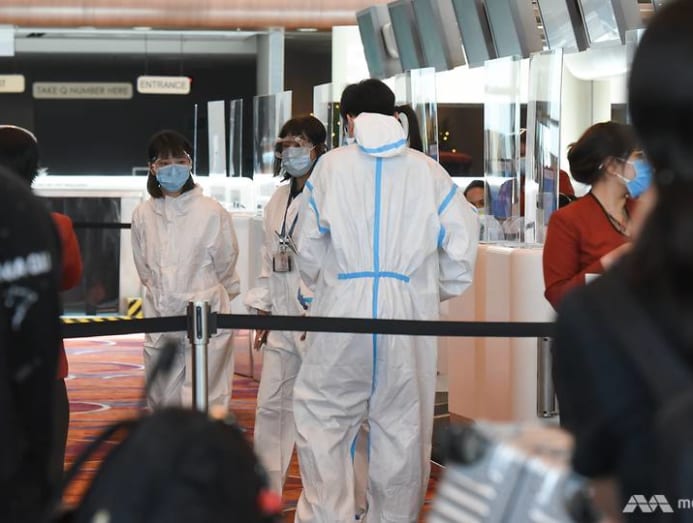
Even so, the increase in flights and passenger volumes are even so "rather insignificant", said aviation annotator Shukor Yusof.
"Airlines wing considering they have cargo commitments and also to retain slots at certain destinations. Today it'southward not uncommon to find fewer than 30 passengers in a plane that could fill 300," said the head of aviation consultancy Endau Analytics.
Requirements such equally quarantine periods and vaccination requirements are still obstacles to hassle-gratis travel, said Mr Shukor, adding that a total recovery may accept a year or more.
"Not withstanding the ramp up in vaccinations, airports and airlines in our part of the world will continue to struggle until cross-border issues are fully resolved," he said.
Last Fri, Singapore'southward multi-ministry task forcefulness tackling COVID-19 said it plans to innovate "vaccinated-differentiated" border measures for travellers from some countries or regions .
Visitors from eight countries – Australia, Austria, Canada, Federal republic of germany, Italy, Norway, South Korea and Switzerland – who are fully vaccinated tin can utilize from Aug 21 to serve their stay-home detect in Singapore at their place of residence rather than a dedicated facility.
Mr Soh, who has clocked more than 4,000 hours in the air in his six years every bit a pilot with Jetstar Asia, said he is "really hopeful" that travel will pick up soon.
"I mean, correct now, our recovery journeying might exist a fleck dull, but I know definitely in fourth dimension it will return," he said.
"People, Singaporeans, they are quite excited to travel, they cannot await to go overseas."

Contempo Searches
Trending Topics
Source: https://cnalifestyle.channelnewsasia.com/singapore/changi-airport-staff-discrimination-covid19-ppe-job-282461
0 Response to "Protecting passengers and themselves: Changi Airport staff on keeping the aviation hub running in the pandemic"
Post a Comment